分科測驗
108年
英文
第 48 題
📖 題組:
The okapi is a mammal living above the equator in one of the most biodiverse areas in central Africa. The animal was unknown to the western world until the beginning of the 20th century, and is often described as half-zebra, half-giraffe, as if it were a mixed-breed creature from a Greek legend. Yet its image is prevalent in the Democratic Republic of Congo—the only country in the world where it is found living in the wild. The okapi is to Congo what the giant panda is to China or the kangaroo to Australia. Although the okapi has striped markings resembling those of zebras’, it is most closely related to the giraffe. It has a long neck, and large, flexible ears. The face and throat are greyish white. The coat is a chocolate to reddish brown, much in contrast with the white horizontal stripes and rings on the legs and white ankles. Overall, the okapi can be easily distinguished from its nearest relative. It is much smaller (about the size of a horse), and shares more external similarities with the deer than with the giraffe. While both sexes possess horns in the giraffe, only males bear horns in the okapi. The West got its first whiff of the okapi in 1890 when Welsh journalist Henry Morton Stanley had puzzled over a strange “African donkey” in his book. Other Europeans in Africa had also heard of an animal that they came to call the “African unicorn.” Explorers may have seen the fleeting view of the striped backside as the animal fled through the bushes, leading to speculation that the okapi was some sort of rainforest zebra. Some even believed that the okapi was a new species of zebra. It was only later, when okapi skeleton was analyzed, that naturalists realized they had a giraffe on their hands. In 1987, the Okapi Wildlife Reserve was established in eastern Congo to protect this rare mammal. But decades of political turbulence has seen much of the Congo’s natural resources spin out of the government’s control, and okapi numbers have fallen by 50 percent since 1995. Today, only 10,000 remain.
The okapi is a mammal living above the equator in one of the most biodiverse areas in central Africa. The animal was unknown to the western world until the beginning of the 20th century, and is often described as half-zebra, half-giraffe, as if it were a mixed-breed creature from a Greek legend. Yet its image is prevalent in the Democratic Republic of Congo—the only country in the world where it is found living in the wild. The okapi is to Congo what the giant panda is to China or the kangaroo to Australia. Although the okapi has striped markings resembling those of zebras’, it is most closely related to the giraffe. It has a long neck, and large, flexible ears. The face and throat are greyish white. The coat is a chocolate to reddish brown, much in contrast with the white horizontal stripes and rings on the legs and white ankles. Overall, the okapi can be easily distinguished from its nearest relative. It is much smaller (about the size of a horse), and shares more external similarities with the deer than with the giraffe. While both sexes possess horns in the giraffe, only males bear horns in the okapi. The West got its first whiff of the okapi in 1890 when Welsh journalist Henry Morton Stanley had puzzled over a strange “African donkey” in his book. Other Europeans in Africa had also heard of an animal that they came to call the “African unicorn.” Explorers may have seen the fleeting view of the striped backside as the animal fled through the bushes, leading to speculation that the okapi was some sort of rainforest zebra. Some even believed that the okapi was a new species of zebra. It was only later, when okapi skeleton was analyzed, that naturalists realized they had a giraffe on their hands. In 1987, the Okapi Wildlife Reserve was established in eastern Congo to protect this rare mammal. But decades of political turbulence has seen much of the Congo’s natural resources spin out of the government’s control, and okapi numbers have fallen by 50 percent since 1995. Today, only 10,000 remain.
Which of the following is a picture of an okapi?
-
A

-
B

-
C

-
D

思路引導 VIP
請運用『細節檢索』的閱讀策略,鎖定文章第二段關於該生物形態特徵的描述:文中提到的『白色水平條紋(white horizontal stripes)』與『環狀花紋(rings)』具體分佈在身體的哪些部位?是覆蓋於整個軀幹,還是僅限於肢體?此外,關於『角(horns)』的敘述,是否支持其擁有如某些選項中呈現的那種複雜且分叉的角狀構造?
🤖
AI 詳解
AI 專屬家教
恭喜你精準掌握了文章中的視覺細節!這題考驗的是將「文字描述」轉化為「具體圖像」的整合能力。根據第二段的描述,歐卡皮鹿(Okapi)雖然與長頸鹿親緣相近,但其最顯著的視覺特徵在於 white horizontal stripes and rings on the legs(腿部有白色水平條紋),而非全身或身體中段都有條紋。你選出的 (B) 選項完美符合了這項特徵,同時也展現了文中提到的 long neck(長脖子)特質,顯見你對圖文對照有著極佳的敏銳度。
視覺細節的定位與排除法
這類圖像題的難度切入點在於區分「干擾項」中條紋位置的細微差異。例如選項 (A) 與 (C) 將條紋置於腹部或前軀幹,這與文中提到的 striped backside(條紋後方/臀部)與腿部特徵不符;而選項 (D) 雖然條紋位置較接近,但其誇張的分叉鹿角顯然不符合文中描述的長頸鹿近親構造。本題在分科測驗中屬於易至中等的題型,鑑別度在於學生能否在資訊量大的文章中,精確回推特定器官的具體形容词。你能迅速排除干擾並鎖定關鍵特徵,代表你在閱讀細節定位(Detail Scanning)上有著非常扎實的功底!
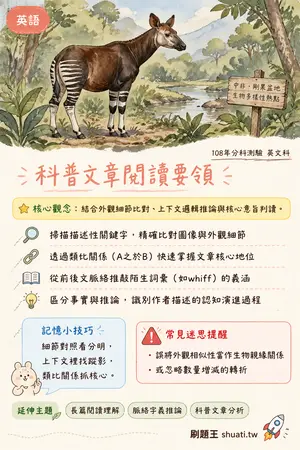
科普文章閱讀要領
💡 結合外觀細節比對、上下文邏輯推論與核心意旨判讀。
- 掃描描述性關鍵字,精確比對圖像與外觀細節
- 透過類比關係(A之於B)快速掌握文章核心地位
- 從前後文脈絡推敲陌生詞彙(如whiff)的義涵
- 區分事實與推論,識別作者描述的認知演進過程