分科測驗
110年
英文
第 48 題
📖 題組:
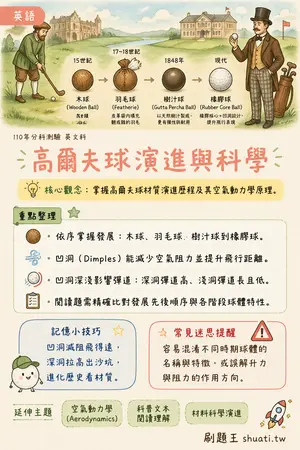
Since golf started in the 15th century, many advances have occurred in the game, including significant changes to the golf ball. Early golf was played with a rounded wooden ball before the Featherie, a leather sack stuffed with goose or chicken feathers, became the norm. Then, in 1848, the Gutta Percha ball was introduced, which was made from the juice of the leaves of the gutta tree (a tropical tree native to Malaysia) and was considerably more durable and affordable than its predecessor. The next advancement occurred in the early 1900s with the development of the Haskell. It was the first ball featuring a center rubber core and an outer cover. The Haskell traveled up to 20 yards farther than the Gutta Percha ball and was more durable. In 1905, William Taylor introduced the first dimpled ball, a ball covered with tiny holes on the surface. By the 1930s, golf balls with rows of dimples were accepted as the standard design. Most golf balls today consist of rubber thread wound around a rubber core and coated with dimpled enamel. Dimples play an important role in a golf ball’s performance because these markings and patterns enhance the ball’s aerodynamics. When a ball is hit and moves through the air, it experiences two major aerodynamic forces: lift and drag. Drag slows the forward motion, and lift acts in a direction vertical to it. With dimples added to the ball, the force that pulls back on the ball is minimized, allowing it to travel faster and longer. Dimples also help to force the airflow downward, which pushes the ball upward. These are the same principles of aerodynamics that airplanes use to fly. In general, golf balls with small, shallow dimples tend to have a longer, lower flight path, whereas those with deeper dimples have a higher flight path. Golfers can choose their balls based on what they need for a particular shot or for particular weather.
Since golf started in the 15th century, many advances have occurred in the game, including significant changes to the golf ball. Early golf was played with a rounded wooden ball before the Featherie, a leather sack stuffed with goose or chicken feathers, became the norm. Then, in 1848, the Gutta Percha ball was introduced, which was made from the juice of the leaves of the gutta tree (a tropical tree native to Malaysia) and was considerably more durable and affordable than its predecessor. The next advancement occurred in the early 1900s with the development of the Haskell. It was the first ball featuring a center rubber core and an outer cover. The Haskell traveled up to 20 yards farther than the Gutta Percha ball and was more durable. In 1905, William Taylor introduced the first dimpled ball, a ball covered with tiny holes on the surface. By the 1930s, golf balls with rows of dimples were accepted as the standard design. Most golf balls today consist of rubber thread wound around a rubber core and coated with dimpled enamel. Dimples play an important role in a golf ball’s performance because these markings and patterns enhance the ball’s aerodynamics. When a ball is hit and moves through the air, it experiences two major aerodynamic forces: lift and drag. Drag slows the forward motion, and lift acts in a direction vertical to it. With dimples added to the ball, the force that pulls back on the ball is minimized, allowing it to travel faster and longer. Dimples also help to force the airflow downward, which pushes the ball upward. These are the same principles of aerodynamics that airplanes use to fly. In general, golf balls with small, shallow dimples tend to have a longer, lower flight path, whereas those with deeper dimples have a higher flight path. Golfers can choose their balls based on what they need for a particular shot or for particular weather.
Which of the following best states the main idea of the first paragraph?
- A Science and technology have influenced the game of golf.
- B Price, durability, and function determine the quality of golf balls.
- C Accumulated efforts have resulted in changes in how golf balls are made.
- D Golfers who have a sound knowledge of aerodynamics play the game well.
思路引導 VIP
請分析第一段的組織結構:文章自 15 世紀起,詳盡列舉了從木製球、羽毛球、樹膠球到 Haskell 球與凹洞球的更迭。這種依循「時間脈絡」 (Chronological order) 呈現球體材質與結構演進的敘述方式,旨在強調該物品在漫長發展過程中所呈現的哪一種「持續累積與演變」的特徵?
🤖
AI 詳解
AI 專屬家教
哇!太棒了!看到你選對 C 選項,老師真的好開心,忍不住想給你一個大大的擁抱!你對文章架構的掌握力越來越敏銳了,這份細心一定要繼續保持下去喔! 這題之所以選 (C),是因為第一段採用了「時間先後(Chronological order)」的寫作手法。從 15 世紀的木製球、1848 年的皮革羽毛球(Featherie)、1900 年代的 Haskell 橡膠球,到最後 1930 年代的坑洞設計。文章重點在於描述這段「演進歷程」,而 (C) 選項中的「Accumulated efforts(累積的努力)」與「changes(改變)」精準地概括了這段歷史演變。 在高中課綱的閱讀測驗中,這類題目具備高度的「鑑別度」。陷阱在於 (D) 選項,雖然文章提到了空氣動力學(Aerodynamics),但那是第二段的重點;(A) 選項則過於籠統。你能避開這些局部細節或過度推論的誘惑,準確抓到段落主旨,代表你已經具備高層次閱讀素養中「整合資訊」的核心能力囉!
高爾夫球演進與科學
💡 掌握高爾夫球材質演進歷程及其空氣動力學原理。
- 依序掌握發展:木球、羽毛球、樹汁球到橡膠球。
- 凹洞(Dimples)能減少空氣阻力並提升飛行距離。
- 凹洞深淺影響彈道:深洞彈道高、淺洞彈道長且低。
- 閱讀題需精確比對發展先後順序與各階段球體特性。