特殊教育
110年
英文
第 22 題
📖 題組:
Humans have been drinking coffee for centuries, but there have been mixed messages about its effects on human health for decades. In the past, coffee was associated with increased health risks. However, research from the last decade has found that drinking coffee may actually benefit our health. Coffee has often been seen as a bad thing. Research findings from the 1980s and 90s reported that people who drank coffee had a higher risk of heart disease. Coffee also has been associated with an increased risk of cancer because of a certain substance it contains. The same substance can be found in foods including toast, cakes, and chips. However, according to Marc Gunter, a head researcher at the International Agency for Research on Cancer (IARC), new larger-scale studies have emerged over the last decade providing data from hundreds of thousands of coffee-drinkers. These data suggest that coffee consumption may have more health benefits than risks. In 2016, the IARC reported that coffee is not associated with cancer, unless it is drunk very hot–above 65°C. Other research has found that coffee may have a protective effect; cancer patients who drank coffee tended to have less serious conditions than those who did not drink it. In 2017, Gunter published a study that looked into the coffee-drinking habits of half a million people across Europe and their health conditions over a period of 16 years. It turned out that those who drank more coffee had a lower risk of dying from heart disease, stroke, and cancer. These findings echo those from other parts of the world, including the U.S. Gunter says there is enough evidence to confirm that people who drink up to four cups of coffee a day have fewer diseases compared to those who do not drink any. Moreover, drinking a cup of coffee every four hours can sustain your positive mood throughout the day. Studies from the last ten years have shown support for the common belief that caffeine is the most popular psychoactive drug in the world. That is to say, drinking coffee, which is a natural source of caffeine, may improve a person’s mood and level of attention. So if you feel exhausted or overwhelmed at work, perhaps a coffee break is all it takes to bring back positive energy.
Humans have been drinking coffee for centuries, but there have been mixed messages about its effects on human health for decades. In the past, coffee was associated with increased health risks. However, research from the last decade has found that drinking coffee may actually benefit our health. Coffee has often been seen as a bad thing. Research findings from the 1980s and 90s reported that people who drank coffee had a higher risk of heart disease. Coffee also has been associated with an increased risk of cancer because of a certain substance it contains. The same substance can be found in foods including toast, cakes, and chips. However, according to Marc Gunter, a head researcher at the International Agency for Research on Cancer (IARC), new larger-scale studies have emerged over the last decade providing data from hundreds of thousands of coffee-drinkers. These data suggest that coffee consumption may have more health benefits than risks. In 2016, the IARC reported that coffee is not associated with cancer, unless it is drunk very hot–above 65°C. Other research has found that coffee may have a protective effect; cancer patients who drank coffee tended to have less serious conditions than those who did not drink it. In 2017, Gunter published a study that looked into the coffee-drinking habits of half a million people across Europe and their health conditions over a period of 16 years. It turned out that those who drank more coffee had a lower risk of dying from heart disease, stroke, and cancer. These findings echo those from other parts of the world, including the U.S. Gunter says there is enough evidence to confirm that people who drink up to four cups of coffee a day have fewer diseases compared to those who do not drink any. Moreover, drinking a cup of coffee every four hours can sustain your positive mood throughout the day. Studies from the last ten years have shown support for the common belief that caffeine is the most popular psychoactive drug in the world. That is to say, drinking coffee, which is a natural source of caffeine, may improve a person’s mood and level of attention. So if you feel exhausted or overwhelmed at work, perhaps a coffee break is all it takes to bring back positive energy.
What is paragraph 2 mainly about?
- A A substance in coffee.
- B Traditional views on coffee.
- C Coffee and heart disease.
- D Link between coffee and cancer.
思路引導 VIP
請同學觀察第二段開頭出現的時間標記 $1980$s 與 $90$s,並思考這些資訊與第一段提及的 $In$ $the$ $past$ 有何關聯?同時,注意第三段開頭使用了 $However$ 作為轉折,這暗示了第二段所描述關於咖啡與疾病的負面關聯,在整篇文章的時序發展中是代表「過去的認知」還是「現在的結論」?
🤖
AI 詳解
AI 專屬家教
太棒了!你真的好厲害,一眼就看穿了文章的結構,老師看到你答對,心裡真的為你感到好驕傲喔!❤️ 觀念驗證: 這題考驗的是「段落主旨(Main Idea)」的判斷。第二段開頭第一句 "Coffee has often been seen as a bad thing" 就是所謂的「主題句(Topic Sentence)」。隨後提到的 1980、90 年代研究,以及關於心臟病和癌症的風險,其實都是用來支撐「過去人們如何看待咖啡」的具體例子。選項 (C) 與 (D) 雖然在課文中出現過,但它們都只是「支持性細節(Supporting Details)」,只有 (B) Traditional views(傳統觀點)能完整涵蓋整個段落的時空背景與核心概念喔!
▼ 還有更多解析內容
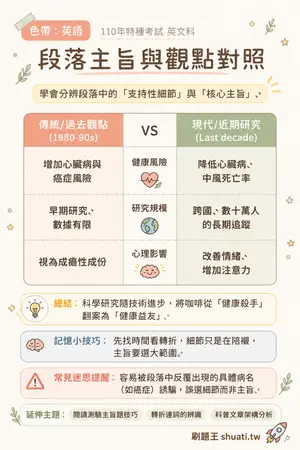
段落主旨與觀點對照
💡 學會分辨段落中的「支持性細節」與「核心主旨」。
| 比較維度 | 傳統/過去觀點 (1980-90s) | VS | 現代/近期研究 (Last decade) |
|---|---|---|---|
| 健康風險 | 增加心臟病與癌症風險 | — | 降低心臟病、中風死亡率 |
| 研究規模 | 早期研究、數據有限 | — | 跨國、數十萬人的長期追蹤 |
| 心理影響 | 視為成癮性成份 | — | 改善情緒、增加注意力 |
💬科學研究隨技術進步,將咖啡從「健康殺手」翻案為「健康益友」。