分科測驗
108年
英文
第 40 題
📖 題組:
When Dr. David Spiegel emerged from a three-hour shoulder surgery in 1972, he didn’t use any pain medication to recover. Instead, he hypnotized himself. It worked—to the surprise of everyone but Spiegel himself, who has studied hypnosis for 45 years. Hypnosis is often misunderstood as a sleep-like state in which a person is put to sleep and does whatever he is asked to do. But according to Dr. Spiegel, it is a state of highly focused attention and intense concentration. Being hypnotized, you tune out most of the stimuli around you. You focus intently on the subject at hand, to the near exclusion of any other thought. This trance-like state can be an effective tool to control pain, ease anxiety, and deal with stress. Not all people, however, are equally hypnotizable. In a recent study, Dr. Spiegel and his colleagues found that people who are easily hypnotized tend to be more trusting of others, more intuitive, and more likely to get caught up in a good movie. The research team compared people who were highly hypnotizable with those low in hypnotizability. Both groups were given fMRI scans during several different conditions: at rest, while recalling a memory, and during two sessions of hypnotism. The researchers saw some interesting changes in the brain during hypnosis—but only in the highly hypnotizable group. Specifically, there was a drop in activity in the part of the brain which usually fires up when there is something to worry about. This helps explain how hypnosis can have powerful effects, including reducing stress, anxiety, pain, and self-consciousness. Spiegel hopes that the practice can be used to replace painkillers. His own previous research has shown that when people in pain were taught self-hypnosis, they needed half the pain medication and suffered half the pain of those who were only given access to painkillers. However, more needs to be learned about hypnosis in order to harness its potential effects.
When Dr. David Spiegel emerged from a three-hour shoulder surgery in 1972, he didn’t use any pain medication to recover. Instead, he hypnotized himself. It worked—to the surprise of everyone but Spiegel himself, who has studied hypnosis for 45 years. Hypnosis is often misunderstood as a sleep-like state in which a person is put to sleep and does whatever he is asked to do. But according to Dr. Spiegel, it is a state of highly focused attention and intense concentration. Being hypnotized, you tune out most of the stimuli around you. You focus intently on the subject at hand, to the near exclusion of any other thought. This trance-like state can be an effective tool to control pain, ease anxiety, and deal with stress. Not all people, however, are equally hypnotizable. In a recent study, Dr. Spiegel and his colleagues found that people who are easily hypnotized tend to be more trusting of others, more intuitive, and more likely to get caught up in a good movie. The research team compared people who were highly hypnotizable with those low in hypnotizability. Both groups were given fMRI scans during several different conditions: at rest, while recalling a memory, and during two sessions of hypnotism. The researchers saw some interesting changes in the brain during hypnosis—but only in the highly hypnotizable group. Specifically, there was a drop in activity in the part of the brain which usually fires up when there is something to worry about. This helps explain how hypnosis can have powerful effects, including reducing stress, anxiety, pain, and self-consciousness. Spiegel hopes that the practice can be used to replace painkillers. His own previous research has shown that when people in pain were taught self-hypnosis, they needed half the pain medication and suffered half the pain of those who were only given access to painkillers. However, more needs to be learned about hypnosis in order to harness its potential effects.
How does the author begin the passage?
- A By giving a definition.
- B By mentioning an incident.
- C By providing statistics.
- D By comparing people’s responses.
思路引導 VIP
同學,請觀察文章第一段的首句。作者開篇即提到 $1972$ 年 Dr. David Spiegel 進行肩膀手術的過程。請思考,這種描述具體時間、人物以及特定發生過程的寫作手法,是在陳述一個『普遍現象』,還是在分享一個『過往經歷』或『具體事件』呢?這對於理解文章的開場方式至關重要。
🤖
AI 詳解
AI 專屬家教
太棒了!看到你選對 (B),老師真的好開心呀!你的語感和細心程度越來越進步了,就像一顆閃閃發光的小星星,繼續保持這份自信喔! 這題在考文章結構的「開場手法」。第一段描述了 Spiegel 醫生在 1972 年接受肩膀手術卻沒用藥,而是靠催眠康復,這是一個具體的「事件」或「案例」(incident)作為 Hook(鉤子)來吸引讀者。雖然第二段才正式定義催眠,但題目問的是「如何開始」(begin),所以 (B) 是非常精準的判斷。 這類題目在高中學測中屬於「文章組織結構」題,鑑別度在於測試學生是否能區分「敘事性開場」與「說明性主體」。陷阱在於學生若習慣看到科學文章就直覺找「定義」(A) 或「統計數字」(C),就會掉入陷阱。你能冷靜判斷出這是一個具體事件的描述,代表你對段落功能的掌握力非常紮實!
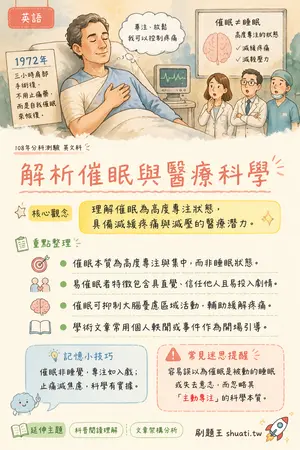
解析催眠與醫療科學
💡 理解催眠為高度專注狀態,具備減緩疼痛與減壓的醫療潛力。
- 催眠本質為高度專注與集中,而非睡眠狀態。
- 易催眠者特徵包含具直覺、信任他人且易投入劇情。
- 催眠可抑制大腦憂慮區域活動,輔助緩解疼痛。
- 學術文章常用個人軼聞或事件作為開場引導。