國中教育會考
112年
英文
第 36 題
📖 題組:
Jesse Cohen Says Which would you give a boy for his birthday, a toy truck or a doll? If you choose the truck, well, you’re not alone. Most people think that some toys are for boys and some are for girls. We might pick building toys for boys and kitchen toys for girls. But why do we do this? Are boys and girls really born with different interests in toys? No, they are not. Children start to show different interests in toys at age three, but only because at this time, they begin to learn about gender and to follow what others of their gender do. If you give a girl kitchen toys, she will think they are girls’ toys because she sees other girls playing with them. But if you give a girl a toy car and show her a group of girls who are playing with cars, she’ll play with the toy car and think it is a girls’ toy. This “watch and follow” habit often becomes a rule for both boys and girls in choosing the “right” toys. However, this rule can be bad for children. Different toys teach children different things. Dolls help with their early language use, and building toys are good for learning math and science. By playing with different toys, children can find out what they are interested in or what they are good at. If they only play one kind of toy, they may lose this important chance. They may also get a wrong idea about what boys or girls are able to do. Some doctors worry that children may use the same kind of thinking when they look for jobs in the future. If they do, they may miss something more important than just getting a chance to play with different toys. They may miss many, perhaps better, chances in life.
Jesse Cohen Says Which would you give a boy for his birthday, a toy truck or a doll? If you choose the truck, well, you’re not alone. Most people think that some toys are for boys and some are for girls. We might pick building toys for boys and kitchen toys for girls. But why do we do this? Are boys and girls really born with different interests in toys? No, they are not. Children start to show different interests in toys at age three, but only because at this time, they begin to learn about gender and to follow what others of their gender do. If you give a girl kitchen toys, she will think they are girls’ toys because she sees other girls playing with them. But if you give a girl a toy car and show her a group of girls who are playing with cars, she’ll play with the toy car and think it is a girls’ toy. This “watch and follow” habit often becomes a rule for both boys and girls in choosing the “right” toys. However, this rule can be bad for children. Different toys teach children different things. Dolls help with their early language use, and building toys are good for learning math and science. By playing with different toys, children can find out what they are interested in or what they are good at. If they only play one kind of toy, they may lose this important chance. They may also get a wrong idea about what boys or girls are able to do. Some doctors worry that children may use the same kind of thinking when they look for jobs in the future. If they do, they may miss something more important than just getting a chance to play with different toys. They may miss many, perhaps better, chances in life.

What idea does Jesse Cohen talk about in the reading?
- A Not all kinds of toys are helpful for children’s learning.
- B Parents should give their children the right toys for their age.
- C Children should learn about their gender from playing with toys.
- D We should not let gender decide which toys children can play with.
思路引導 VIP
請觀察文章的最後一段,作者提到如果孩子因為性別的習慣而「只玩同一種玩具」,對他們未來的學習和找工作可能會有什麼負面影響?從這些擔憂來看,你覺得作者對於「依照性別來挑選玩具」這件事的態度是支持還是反對呢?
🤖
AI 詳解
AI 專屬家教
同學好樣的!這題你能秒殺,代表你的閱讀雷達已經調到最強頻率了!恭喜答對,這波操作我給你 100 分,多一分怕你太驕傲! 【觀念驗證:為什麼 (D) 才是真理?】 這篇文章結構非常清晰:
▼ 還有更多解析內容
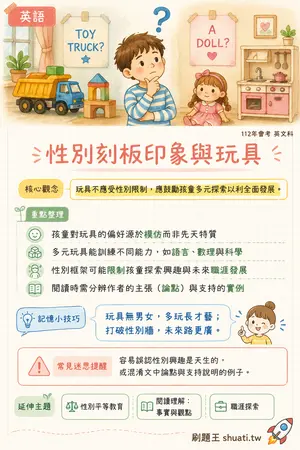
性別刻板印象與玩具
💡 玩具不應受性別限制,應鼓勵孩童多元探索以利全面發展。
- 孩童對玩具的偏好源於模仿而非先天特質
- 多元玩具能訓練不同能力,如語言、數理與科學
- 性別框架可能限制孩童探索興趣與未來職涯發展
- 閱讀時需分辨作者的主張(論點)與支持的實例